


Defeating the Five Kings of the Amorite Alliance

Updated: Feb 19
Wars of the Bible
In the last blog, we read about the Second Battle of Ai and how it was a hard-won turning point for Israel after their first attempt to take the city failed. Unlike Jericho, which fell through divine spectacle, Ai exposed Israel’s vulnerability—revealing that victory in Canaan was not automatic, but contingent on obedience to God. Only after their sin was confronted and they repented did Joshua bring the Israelites back into alignment with the Lord’s command. Ai fell not by miracle alone, but through discipline, strategy, and renewed faithfulness.
That victory did more than secure a city. It sent a signal across Canaan: Israel was not a passing raiding force. They adapted, learned, and pressed forward with purpose. The central hill country now lay open, and the old assumptions about how these invading people could be resisted no longer remained.
In the wake of Ai’s destruction, the Gibeonites made their move. Choosing deception over defiance, they secured a treaty with Israel that bound Joshua by oath before the Lord. Though the covenant was made under false pretenses, it was honored without hesitation. Israel would not break faith, even when doing so proved costly.
Gibeon was no minor village. It was a great, well-fortified city, home to seasoned warriors and located along vital routes through the hill country. Its decision to align with Israel, along with it’s Hiviite cities that included Chephirah, Beeroth, and Kiriath-jearim, transformed the conflict from a series of isolated engagements into a political and military crisis for the kings of Canaan. If a city of Gibeon and its associated cities could survive by submitting to Israel, others might follow.
The response was swift and decisive. Five kings of the Amorite hill country did not march against Israel first—they moved to annihilate Gibeon, to punish defection, and send a warning to anyone who might consider peace with Joshua.
Bound by covenant and compelled by faithfulness, Israel was drawn into a battle not of its choosing, against an alliance larger and more dangerous than any faced before. Joshua 10 records the moment when treaty loyalty, military necessity, and divine intervention collide—ushering Israel into a war that would redefine how victory itself was understood.
The Sun Stands Still
10 As soon as Adoni-zedek, king of Jerusalem, heard how Joshua had captured Ai and had devoted it to destruction,[a] doing to Ai and its king as he had done to Jericho and its king, and how the inhabitants of Gibeon had made peace with Israel and were among them, 2 he[b] feared greatly, because Gibeon was a great city, like one of the royal cities, and because it was greater than Ai, and all its men were warriors. 3 So Adoni-zedek king of Jerusalem sent to Hoham king of Hebron, to Piram king of Jarmuth, to Japhia king of Lachish, and to Debir king of Eglon, saying, 4 “Come up to me and help me, and let us strike Gibeon. For it has made peace with Joshua and with the people of Israel.” 5 Then the five kings of the Amorites, the king of Jerusalem, the king of Hebron, the king of Jarmuth, the king of Lachish, and the king of Eglon, gathered their forces and went up with all their armies and encamped against Gibeon and made war against it.
6 And the men of Gibeon sent to Joshua at the camp in Gilgal, saying, “Do not relax your hand from your servants. Come up to us quickly and save us and help us, for all the kings of the Amorites who dwell in the hill country are gathered against us.” 7 So Joshua went up from Gilgal, he and all the people of war with him, and all the mighty men of valor. 8 And the Lord said to Joshua, “Do not fear them, for I have given them into your hands. Not a man of them shall stand before you.” 9 So Joshua came upon them suddenly, having marched up all night from Gilgal. 10 And the Lord threw them into a panic before Israel, who[c] struck them with a great blow at Gibeon and chased them by the way of the ascent of Beth-horon and struck them as far as Azekah and Makkedah. 11 And as they fled before Israel, while they were going down the ascent of Beth-horon, the Lord threw down large stones from heaven on them as far as Azekah, and they died. There were more who died because of the hailstones than the sons of Israel killed with the sword.
12 At that time Joshua spoke to the Lord in the day when the Lord gave the Amorites over to the sons of Israel, and he said in the sight of Israel,
“Sun, stand still at Gibeon, and moon, in the Valley of Aijalon.”
13
And the sun stood still, and the moon stopped, until the nation took vengeance on their enemies.
Is this not written in the Book of Jashar? The sun stopped in the midst of heaven and did not hurry to set for about a whole day. 14 There has been no day like it before or since, when the Lord heeded the voice of a man, for the Lord fought for Israel.
15 So Joshua returned, and all Israel with him, to the camp at Gilgal.
Five Amorite Kings Executed
16 These five kings fled and hid themselves in the cave at Makkedah. 17 And it was told to Joshua, “The five kings have been found, hidden in the cave at Makkedah.” 18 And Joshua said, “Roll large stones against the mouth of the cave and set men by it to guard them, 19 but do not stay there yourselves. Pursue your enemies; attack their rear guard. Do not let them enter their cities, for the Lord your God has given them into your hand.” 20 When Joshua and the sons of Israel had finished striking them with a great blow until they were wiped out, and when the remnant that remained of them had entered into the fortified cities, 21 then all the people returned safe to Joshua in the camp at Makkedah. Not a man moved his tongue against any of the people of Israel.
22 Then Joshua said, “Open the mouth of the cave and bring those five kings out to me from the cave.” 23 And they did so, and brought those five kings out to him from the cave, the king of Jerusalem, the king of Hebron, the king of Jarmuth, the king of Lachish, and the king of Eglon. 24 And when they brought those kings out to Joshua, Joshua summoned all the men of Israel and said to the chiefs of the men of war who had gone with him, “Come near; put your feet on the necks of these kings.” Then they came near and put their feet on their necks. 25 And Joshua said to them, “Do not be afraid or dismayed; be strong and courageous. For thus the Lord will do to all your enemies against whom you fight.” 26 And afterward Joshua struck them and put them to death, and he hanged them on five trees. And they hung on the trees until evening. 27 But at the time of the going down of the sun, Joshua commanded, and they took them down from the trees and threw them into the cave where they had hidden themselves, and they set large stones against the mouth of the cave, which remain to this very day.
Joshua 10:1-27
Archaeology and Geography: Gibeon and the Hivite Cities
The events of Joshua 9–10 unfold within a tightly defined geographical corridor in the central hill country of Canaan. While archaeology cannot “prove” the miracle recorded in Joshua 10, it does allow us to anchor the narrative in real places, known trade routes, and an identifiable political landscape that aligns closely with the biblical account.
Gibeon (el-Jib)
Gibeon is widely and confidently identified with el-Jib, located approximately five miles northwest of Jerusalem. Excavations conducted in the 1950s and 1960s uncovered substantial evidence that matches the biblical description of Gibeon as a “great city.”
Key findings include:
Massive fortification systems dating to the Late Bronze Age.
A sophisticated water system carved deep into bedrock.
Extensive wine-production facilities, suggesting wealth and regional importance.
These discoveries support the biblical claim that Gibeon was “like one of the royal cities” and help explain why its defection triggered such alarm among the Amorite kings. Gibeon was not a peripheral settlement—it was a strategic and economic hub controlling access through the hill country.
The Hivite Confederation
Joshua 9 identifies Gibeon as the head of a small league of Hivite cities, including:
Chephirah
Beeroth
Kiriath-jearim
Together, these cities formed a compact network north and west of Jerusalem, occupying high ground along important east–west and north–south routes.
Chephirah
Likely identified with Kefireh, Chephirah sat west of Gibeon along the road toward the coastal plain. Its position suggests a role in trade and communication between inland hill settlements and the lowlands.
Beeroth
Commonly associated with el-Bireh, Beeroth lay along the central ridge route later known as the “Way of the Patriarchs.” This placement would have given it both economic value and military relevance.
Kiriath-jearim
Often identified with Deir el-Azar or Abu Ghosh, Kiriath-jearim was located on a forested ridge that controlled access to Jerusalem from the west. Its later biblical significance as a resting place for the Ark underscores its enduring importance.
Archaeological surveys across these sites show patterns of occupation consistent with the Late Bronze Age, reinforcing the plausibility of a regional coalition acting together in response to Israel’s advance.
The Battlefield Corridor
Joshua 10 traces a clear pursuit route:
Gibeon
Upper and Lower Beth-horon
Azekah
Makkedah

This path follows a steep descent from the central highlands into the Shephelah. Militarily, it is a natural choke point—ideal for ambush, panic, and rout. Any army retreating down the Beth-horon ascent would be vulnerable to disorder, exactly as the text describes.
The geography also explains the narrative emphasis on pursuit rather than siege. Once the Amorite coalition broke, the terrain itself amplified their defeat.
Archaeology and the Biblical Claim
It must be said plainly: archaeology does not—and cannot—verify the sun standing still. What it can do is confirm that:
The cities named are real and correctly situated.
Gibeon was a major fortified center.
The military routes described make strategic sense.
The political reaction to Gibeon’s treaty is historically plausible.
In other words, the biblical narrative is not floating in mythic abstraction. It is embedded in a real landscape, populated by real cities, responding to pressures that archaeology and geography together help us understand.
The miracle of Joshua 10 is not presented as legend detached from history, but as divine action breaking into a very specific moment, in a very real war, fought on known ground.
The Five Kings of the Amorite Alliance
Joshua 10 introduces five kings ruling over key city-states of southern Canaan:
Jerusalem
Hebron
Jarmuth
Lachish
Eglon
These were not tribal chieftains, but urban monarchs governing fortified cities, each commanding trained warriors and regional influence. Together, they represented a significant portion of Amorite power in the hill country and Shephelah.
The term “Amorite” here functions less as a narrow ethnic label and more as a geopolitical one. In Late Bronze Age Canaan, “Amorite” could describe a class of highland rulers and warrior elites, often contrasted with coastal city-states aligned with Egypt. This alliance reflects a shared political culture, mutual defense interests, and a recognition that Israel posed an existential threat to their way of life.
Jerusalem’s inclusion is especially noteworthy. At this stage, it is already a prominent royal city, centuries before David would capture it. The king of Jerusalem taking leadership in forming the coalition underscores both the city’s importance and the seriousness of the threat Israel posed.
This was not a desperate last stand. It was a calculated, unified attempt to stop Israel’s momentum before more cities defected.
Military and Strategic Considerations
From a military perspective, the alliance’s decision to attack Gibeon rather than Israel directly was sound. Gibeon sat astride key routes through the central highlands. Holding it—or destroying it—meant controlling movement between north and south.
Joshua’s response was equally strategic. Rather than fortifying or waiting, he executed a rapid overnight march from Gilgal, achieving surprise against a numerically superior enemy.
The battle unfolds in three phases:
Surprise assault at Gibeon.
Pursuit through the ascent of Beth-horon.
Total collapse of the coalition under divine intervention.
The text emphasizes that Israel’s victory was not merely tactical. Panic, disarray, and destruction are explicitly attributed to the Lord’s direct action, culminating in the unprecedented event of extended daylight.
Biblical Scholarship and the “Sun Standing Still”
Joshua 10:12–14 has long been one of the most discussed passages in biblical studies. The poetic quotation—attributed to the Book of Jashar—marks this as a preserved victory hymn or epic fragment embedded within the narrative.
Scholars generally agree on several points:
The text intends to communicate divine intervention, not merely metaphorical encouragement.
The language is phenomenological—describing the event as it appeared from the ground, not as a scientific treatise.
The author’s emphasis is theological: the Lord fought for Israel.

Some interpret the event as a literal astronomical miracle; others suggest prolonged light through atmospheric phenomena, symbolic language, or poetic amplification of an unusually decisive victory. What unites these interpretations is that the text itself leaves no doubt about agency: Israel wins because God intervenes decisively in history.
Verse 14 stands as the interpretive key:
“There has been no day like it before or since… for the Lord fought for Israel.”
The miracle is not ultimately about the sun or moon—it is about covenant obedience, divine sovereignty, and God’s willingness to reorder creation itself to fulfill His promises.
The Fate of the Five Kings: Power Reversed
The capture and execution of the five kings at Makkedah carries deep symbolic weight. In the ancient Near East, placing one’s foot on the neck of a defeated king was a ritualized declaration of total subjugation.
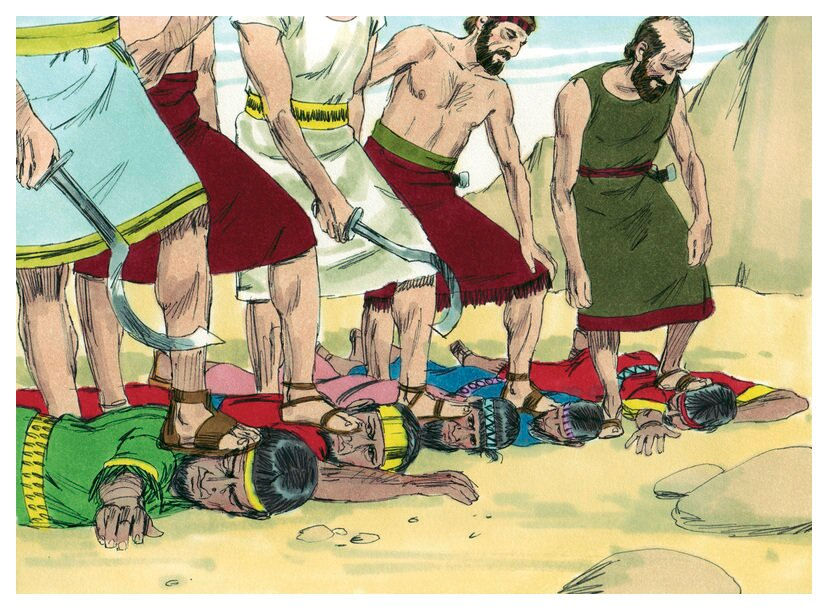
Joshua’s command to his officers—“Do not be afraid or dismayed; be strong and courageous”—transforms the scene into a living lesson. The once-feared rulers of the land are rendered powerless, their authority publicly dismantled.
Their execution and burial in the very cave where they sought refuge underscores a recurring biblical theme: those who oppose God’s purposes cannot ultimately hide from judgment.

My Spiritual Takeaway
The Story of Joshua 10 is interesting. Yet again, we have the Israelites making a decision without consulting the Lord (the treaty with the Gibeonites), as well as overcoming a superior force with help from God’s divine intervention. This teaches two important lessons.
Always Consult the Lord
Anything we do in life, we should take to the Lord and consult with him. Is this what He wants for us? Is this what He thinks is best for you? It’s extremely hard for us to do this in the moment, for we are so reliant on ourselves at times and drift from God. That usually leads to disaster. For the Israelites, it meant being deceived into entering into a covenant they had to fulfill with the Gibeonites.
Don’t Fear The Worldly Might Of Those That Stand Against You
The alliance of these five Amorite kings brought together a massive force that must have struck fear into the Israelite army. But they had the Lord on their side. This is a good reminder that we will always be outnumbered, especially in this modern world, by those who would gladly applaud our failure and destruction. But they all will face God’s judgment, no matter how far they try to run and hide. We must commit ourselves to the Lord and stand firm in our faith.
In the next blog, we’ll look at Joshua’s conquest of Southern and Northern Canaan, leading to the fall of seven great cities.
Sources
Aharoni, Y. (1979). The land of the Bible: A historical geography (2nd ed.). Westminster Press.
Albright, W. F. (1957). From the Stone Age to Christianity: Monotheism and the historical process (2nd ed.). Doubleday.
Bright, J. (1981). A history of Israel (3rd ed.). Westminster John Knox Press.
Dever, W. G. (2001). What did the biblical writers know and when did they know it? What archaeology can tell us about the reality of ancient Israel. Eerdmans.
Finkelstein, I., & Silberman, N. A. (2001). The Bible unearthed: Archaeology’s new vision of ancient Israel and the origin of its sacred texts. Free Press.
Hess, R. S. (1996). Joshua: An introduction and commentary. InterVarsity Press.
Howard, D. M. (1998). Joshua: An exegetical and theological exposition of Holy Scripture (NAC). Broadman & Holman.
Kitchen, K. A. (2003). On the reliability of the Old Testament. Eerdmans.
Kline, M. G. (1963). Treaty of the Great King: The covenant structure of Deuteronomy. Eerdmans.
Levy, T. E. (Ed.). (2014). The archaeology of society in the Holy Land. Bloomsbury.
Mazar, A. (1990). Archaeology of the land of the Bible, 10,000–586 B.C.E. Doubleday.
Na’aman, N. (1994). The Canaanite city-states in the Late Bronze Age. Ugarit-Forschungen, 26, 397–418.
Rainey, A. F., & Notley, R. S. (2006). The sacred bridge: Carta’s atlas of the biblical world. Carta Jerusalem.
The Holy Bible, English Standard Version. (2001). Crossway Bibles. Joshua 10. Retrieved January 28, 2026, from https://www.biblegateway.com/passage/?search=Joshua%2010&version=ESV
Younger, K. L. (1990). Ancient conquest accounts: A study in ancient Near Eastern and biblical history writing. Sheffield Academic Press.
Images
Bible Illustrations by Sweet Media. (n.d.). Book of Joshua chapter 10–4 [Illustration]. Wikimedia Commons. https://commons.wikimedia.org/wiki/File:Book_of_Joshua_Chapter_10-4_(Bible_Illustrations_by_Sweet_Media).jpg
Bible Illustrations by Sweet Media. (n.d.). Book of Joshua chapter 10–7 [Illustration]. Wikimedia Commons. https://commons.wikimedia.org/wiki/File:Book_of_Joshua_Chapter_10-7_(Bible_Illustrations_by_Sweet_Media).jpg
Bible Illustrations by Sweet Media. (n.d.). Book of Joshua chapter 10–8 [Illustration]. Wikimedia Commons. https://commons.wikimedia.org/wiki/File:Book_of_Joshua_Chapter_10-8_(Bible_Illustrations_by_Sweet_Media).jpg
Bible Mapper Atlas. (2020, October 30). The conquest of Canaan: The southern campaign [Map/Blog post]. BibleMapper.com. https://biblemapper.com/blog/index.php/2020/10/30/the-conquest-of-canaan-the-southern-campaign/
Martin, J. (c. 1822). Joshua commanding the sun to stand still upon Gibeon (Joshua 10:12–14) [Drawing]. Wikimedia Commons. https://commons.wikimedia.org/wiki/File:Joshua_Commanding_the_Sun_to_Stand_Still_Upon_Gibeon_(Joshua-_10-_12%E2%80%9314)_MET_DP821098.jpg


Comments