


The Victory Upon the Plain (Part 1)

Wars of the Bible
Continuing through Judges, we pick up the story after Deborah and Barak had successfully defeated Jabin, king of Canaan. Once again, the Israelites “did what was evil in the sight of the Lord” (Judges 6:1), finding themselves oppressed by the Midianites for seven years. This time, we learn that the Midianites, Amalekites, and other peoples of “the east” had come into their land, ravaging their crops. It has gotten so bad that the Israelites have had to retreat into “the mountains and the caves and the strongholds” (Judges 6:2).
An angel of the Lord then approaches Gideon, and he’s anointed as the leader who will deliver the Israelites from the Midianites' hands. This is a particularly powerful scene, for we see Gideon moving from doubt and skepticism to a faithful servant of the Lord. He says, “Please, Lord, how can I save Israel? Behold, my clan is the weakest in Manasseh, and I am the least in my father's house” (Judges 6:16).
We see consistently throughout the bible God choosing those who feel themselves unworthy. After receiving proof that he was indeed speaking with the Lord, Gideon builds an altar at Ophrah to God and is then commanded to destroy the altar that the Israelites have raised to Baal. In this act and the events that follow, Gideon receives a new name (another theme in the bible), Jerubaal, which translates to “Let Baal contend against him.” Then comes the vast army of the Midianites and their allies.
33 Now all the Midianites and the Amalekites and the people of the East came together, and they crossed the Jordan and encamped in the Valley of Jezreel. 34 But the Spirit of the Lord clothed Gideon, and he sounded the trumpet, and the Abiezrites were called out to follow him. 35 And he sent messengers throughout all Manasseh, and they too were called out to follow him. And he sent messengers to Asher, Zebulun, and Naphtali, and they went up to meet them.
Judges 6:33-35
This sets the stage for a major battle that doesn’t go as one might expect. The Lord has a better plan and guides Gideon in facing the Midianite threat.
Gideon’s Three Hundred
Gideon had raised an army of thirty-two thousand. But the Lord said, “The people with you are too many for me to give the Midianites into their hand, lets Israel boast over me, saying ‘My own hand has saved me’” (Judges 7:2)
God then tells Gideon to let anyone who is fearful or trembling at the coming battle leave. Twenty-two thousand men in the army departed, leaving ten thousand. To whittle the force down further, he tells Gideon to take them down to the water, for the Lord says, “I will test them for you there, and anyone of whom I say to you, ‘This one shall go with you,’ shall go with you, and anyone of whom I say to you, ‘This one shall not go with you,’ shall not go” (Judges 7:4).
The test comes in the form of how the men drink the water. “Every one who laps the water with his tongue, as a dog laps, you shall set by himself. Likewise, every one who kneels down to drink.” And the number of those who lapped, putting their hands to their mouths, was 300 men, but all the rest of the people knelt down to drink water. (Judges 5-6).
With these 300 men, the Lord promises Gideon to “give the Midianites” into his hand. But how they do it is not initially by a force of arms but by using trumpets, jars, and torches to conduct what we would call in modern military terms a “psychological operation (psyop) with the intent to spark fear and demoralize the Midianites. This is how they do it.
Gideon Defeats Midian
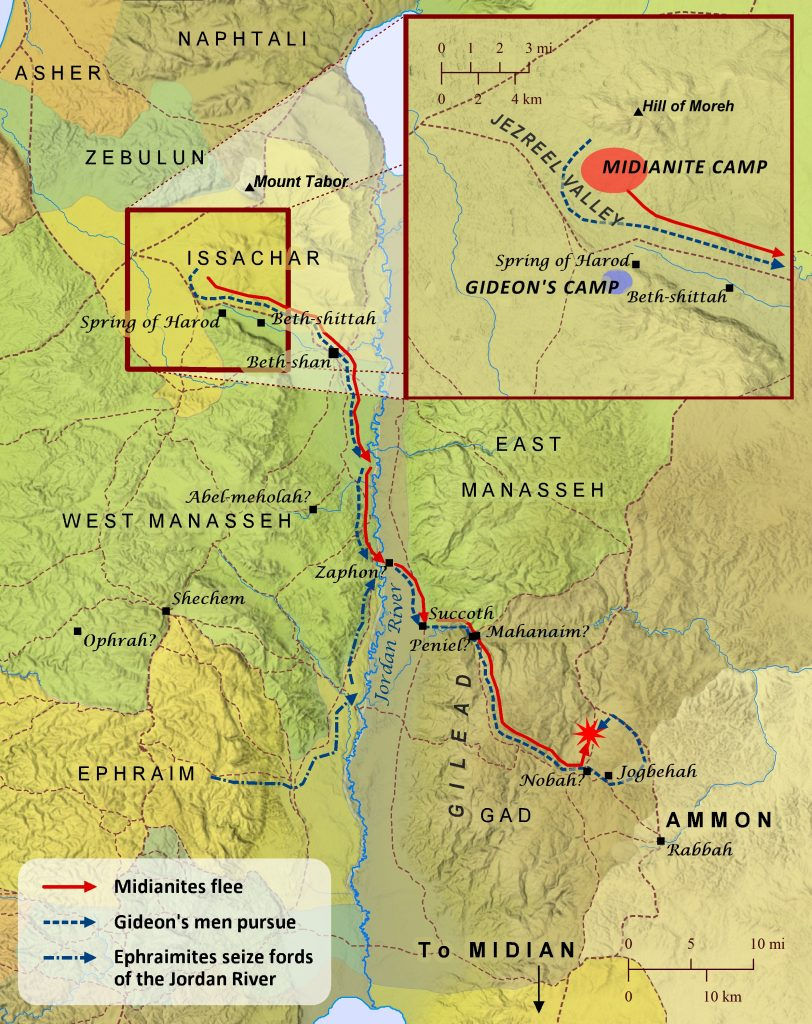
19 So Gideon and the hundred men who were with him came to the outskirts of the camp at the beginning of the middle watch, when they had just set the watch. And they blew the trumpets and smashed the jars that were in their hands. 20 Then the three companies blew the trumpets and broke the jars. They held in their left hands the torches, and in their right hands the trumpets to blow. And they cried out, “A sword for the Lord and for Gideon!” 21 Every man stood in his place around the camp, and all the army ran. They cried out and fled. 22 When they blew the 300 trumpets, the Lord set every man's sword against his comrade and against all the army. And the army fled as far as Beth-shittah toward Zererah,[a] as far as the border of Abel-meholah, by Tabbath. 23 And the men of Israel were called out from Naphtali and from Asher and from all Manasseh, and they pursued after Midian.
24 Gideon sent messengers throughout all the hill country of Ephraim, saying, “Come down against the Midianites and capture the waters against them, as far as Beth-barah, and also the Jordan.” So all the men of Ephraim were called out, and they captured the waters as far as Beth-barah, and also the Jordan. 25 And they captured the two princes of Midian, Oreb and Zeeb. They killed Oreb at the rock of Oreb, and Zeeb they killed at the winepress of Zeeb. Then they pursued Midian, and they brought the heads of Oreb and Zeeb to Gideon across the Jordan.
Judges 7:19-25
What do we know about these events historically?
In most of my blogs, we come to find that the archaeological or historical record is lacking to fully corroborate the story. But in the case of Gideon, there’s a body of evidence that’s quite compelling.
Famine conditions
Archaeologists studying pollen, combined with texts from Egypt and Turkey, reveal that there was a region-wide upheaval due to famine in Israel and the surrounding areas. This occurred at the end of the 12th century B.C., which aligns with the time period of these events.
Midianite cultural evidence
Known by two names, simply “Midianite Pottery” or “Qurayyah Painted Ware” (Quarayyah is located in northwest Saudi Arabia, identified as the place of origin and also fits within the geographical bounds of biblical Midian) has been discovered across the region. This pottery dates to the 13th to 12th Centuries BC, aligning with the time period of Gideon. While this could be attributed to trade rather than the presence of Midianites, it remains compelling evidence of these peoples in the region at this time.
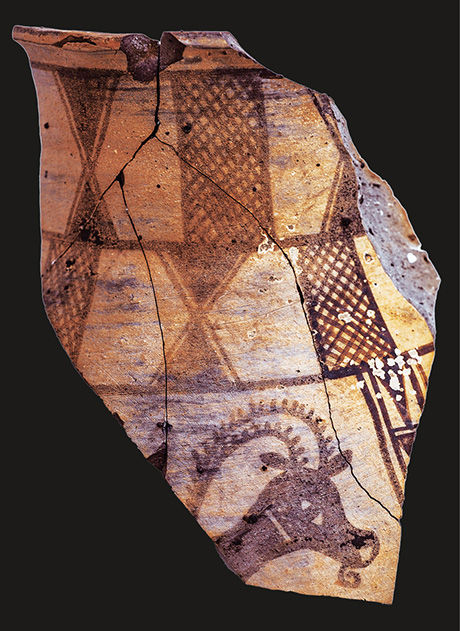
However, the Midianite culture appears to disappear from the record at the end of the century. It’s unclear how or why, but this aligns with their destruction by the hands of the Israelites. In an interesting note, Egyptologist Kenneth Kitchen stated in his book On the Reliability of the Old Testament,
“After that date the Egyptians left [Timna, a region in southern Israel just north of the Gulf of Aqaba, circa 1150 b.c.e.], and for a short time the Midianites/Qurayyaites stayed around and built their own tent shrine, leaving when a rockfall crushed it. By around 1100 or so they were gone.”
The destruction of this shrine also echoes in the story of Gideon.
Occupation of Succoth
In the text, Succoth and Penuel are two trans-Jordan Israelite cities that Gideon and his weary men pass in their pursuit of the Midianite army. Both cities refused to aid them, not believing that they had routed the Midianites. Their judgment would come later upon Gideon’s return after defeating the Midianites.
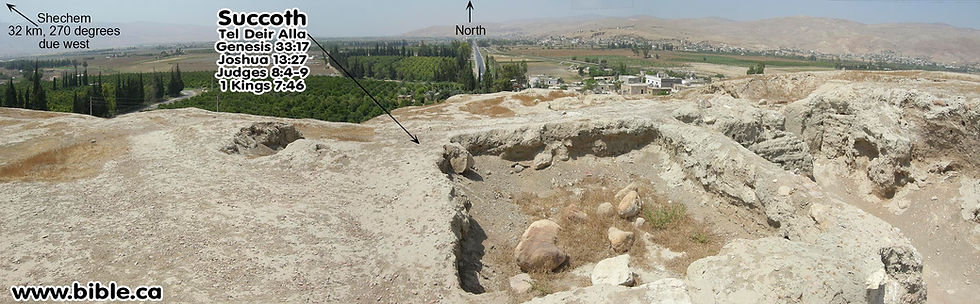
The site of Succoth has been identified as Deir ‘Alla just beyond the Jordan River. The archaeological record reveals that an occupation of the city took place at this time (destruction of the storerooms at this time serves as evidence).
The Ostracon
Back in the summer of 2021, Prof. Yossi Garfinkel revealed his team had discovered an ostracon at the site of Khirbet al-Ra’i. This shard of pottery had the name “Jerubaal” written on it. The ostracon serves as the first piece of contemporary evidence with that name inscribed on it. It’s still debatable whether this is Gideon or someone else who bears this name.

However, it’s dated to the same time period. We know that the fame of Jerubbaal spread across the entire region and that he had 70 sons, which means his family populated this area. The discovery location is 120 kilometers from the famous battlespot and lies within the geographical region where Midianite oppression took place. The name itself is rare, only mentioned once in the bible and now on this shard. And lastly, the name doesn’t necessarily mean to favor either God or Baal, which further supports its rarity of use.
Gideon’s cave
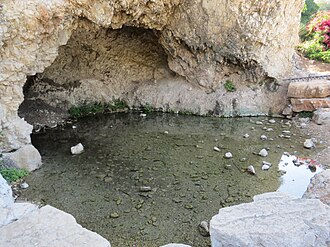
Since 1856, the “Well of Harod,” called the “spring of Harod” in the English Standard Version of verse 3, has been identified with the site of Ain Jalut (meaning Spring of Goliath). It’s believed that the geographic location was mistaken, hence the name, or that Jalut could possibly be a corruption of the name Gilead, which is mentioned in verse 3 as well.
It’s important to note that the Mountains of Gilead are nowhere near this biblical location. However, one of the mountaintops near Ain Jalut spring is a rock formation known as the gilead. It measures 8 x 10 meters and existed during this time period.
Arabic-named sites match key places
In addition to Ain Jalut, two other names that potentially align with the story include Oreb and Zeeb, captured by Gideon at two sites near the Jordan River (the rock of Oreb and the winepress of Zeeb). These words translate to “raven” and “wolf,” respectively. What’s interesting is there are conical hills near Jericho. Their old Arabic names translate to the “raven’s nest” and “ridge of the wolf,” which could suggest a connection to the story of Judges.
A force of 300 warriors
Between seven hundred to eight hundred years before King Leonidas made his stand with his famous 300 Spartan warriors at Thermopylae, we have Gideon commanding a force of similar size. What’s interesting is that the Spartans considered themselves descendants of the Israelites, revealing “kinship diplomacy” between these states during a time when both faced powerful external threats. Greek stories often parallel those of the bible. But moreover, from a pure practical perspective, three hundred warriors is the largest a single commander could control in battle effectively in ancient times. Historians have argued that’s probably another reason why it shows up so many times in other stories.
My spiritual takeaways
Of all the events I’ve covered so far, this one has provided the most compelling evidence. While it’s not definitive proof, it does seem too coincidental that all of these things have come together in the area in question. But belief in the historicity of the events in the Old Testament as well as their accuracy should not override one’s faith in God. C.S. Lewis classified the different stories in the Old Testament, such as Jonah and Job, as moral tales or religious literature where lessons of the story were more important than whether they were factual.
However, he contended that the New Testament was indeed historical, given how it was written (eyewitness accounts rather than thematic myths). I felt that was important to mention at this juncture, for I do not want to give the impression I am trying to prove the validity of these events. Rather, I am trying to ground us in these events from what we know to further enhance our appreciation and understanding of the text.
So, let’s transition now to my spiritual takeaways.
Doubt is normal and one of our weaknesses
When the angel approaches Gideon, we see him doubt who he was really speaking to (God). So much so, he asks for proof. We often want that proof as well, for it reassures us in a world where the enemy is trying to tempt us away from the Lord. He uses our doubt as a weapon, and we must recognize that doubt is part of the human experience. But it should not rule us, and we must do things to actively fight against it taking control (reading the bible, praying actively, etc.)
All the glory goes to God, not us
God whittles down Gideon’s force because He knew that if the Israelites were victorious with such a force, they would take the glory rather than giving it to God. It’s a good reminder that the successes we achieve in life should always be attributed to the Lord. Too many become their own Gods, and inevitably, this leads to destruction.
This story is not over. In Part 2, we’ll take a look at Gideon’s return with his three hundred warriors and their final defeat of the armies from the east.
Read Next Blog
Sources
Armstrong Institute of Biblical Archaeology. (n.d.). Camels: Proof that the Bible is false? https://armstronginstitute.org/153-camels-proof-that-the-bible-is-false
Armstrong Institute of Biblical Archaeology. (n.d.). Gideon v. Midian: Evidence for the biblical account. https://armstronginstitute.org/382-gideon-v-midian-evidence-for-the-biblical-account
Bible Gateway. (n.d.). Judges 6 (English Standard Version). https://www.biblegateway.com/passage/?search=Judges%206&version=ESV
Images
Armstrong Institute of Biblical Archaeology. (n.d.). Gideon v. Midian: Evidence for the biblical account. https://armstronginstitute.org/382-gideon-v-midian-evidence-for-the-biblical-account
Bible.ca. (n.d.). Tell Deir Alla (Succoth) and the Balaam inscription (1400–750 BC). https://www.bible.ca/archeology/bible-archeology-balaam-son-of-beor-inscription-tell-deir-alla-succoth-1400-750bc.htm
Bible Mapper Blog. (2022, January 31). Gideon defeats the Midianites. https://biblemapper.com/blog/index.php/2022/01/31/gideon-defeats-the-midianites/
Wikimedia Commons contributors. (n.d.). Gideon and His Three Hundred (Bible Card) [Photograph]. Wikimedia Commons. https://commons.wikimedia.org/wiki/File:Gideon_and_His_Three_Hundred_(Bible_Card).jpg
Wikipedia contributors. (n.d.). Ma'ayan Harod. Wikipedia. https://en.wikipedia.org/wiki/Ma%27ayan_Harod

Comments