


What if: Force Z Intercepts Japan’s Malayan Invasion Fleet

The night of 9 December 1941, two great silhouettes carved through the darkness. HMS Prince of Wales and HMS Repulse were the backbone of the Royal Navy’s Far East deterrent. Together with four destroyers, these ships formed Force Z, a hastily assembled but symbolically potent response to Japanese aggression in the region. Rushed to the area under the orders of British Prime Minister Winston Churchill, Force Z was a paltry force considering what they would face, especially in air power.
On the bridge of Prince of Wales, Admiral Sir Tom Phillips was determined that stealth, speed, and the old instincts of surface warfare could still shift the balance. If he could catch Japan’s invasion fleet before land-based bombers found him, he might strike the first meaningful blow of Britain’s Pacific war.
Unfortunately, he never got the chance. But what if he did? We’ll take a look at this scenario, starting with the actual history before diving into the potential effects of a surface engagement.
The Japanese Invasion of Malaya
The Japanese invasion of Malaya was a tri-pronged landing operation involving Kota Bharu, Singora, and Patani. Japan’s war machine had tanks, planes, and elite infantry, but what it lacked was the unglamorous backbone of any maritime empire—transports. The Japanese at this point do not have enough assault shipping to do simultaneous landings. The shipping used for the Malaya invasion would quickly be recalled to conduct the Invasion of the Philippines.

If Phillips had met this force at sea or as they were disembarking the invasion force, it would have inevitably affected other operations. Yet at the start of the war, things seemed to be going Japan's way, with high-tempo operational momentum and air power shaping both land and sea battles, making up for what could've been major setbacks.
Force Z’s Mission and Position
Force Z was a symbol of British resolve, but in reality, it was insufficient to stand up to or deter the Japanese.
The force was composed of the following vessels:
HMS Prince of Wales (King George V-class battleship)
HMS Repulse (Renown-class battlecruiser)
HMS Electra (E-class destroyer), HMS Express (E-class minelaying destroyer), HMS Vampire (V-class destroyer), and HMS Tenedos (S-class destroyer).
Phillips’ mission was straightforward: intercept the Japanese landings before they could consolidate. His flaw was the belief that speed and surprise could compensate for the absence of
aircraft carriers as well as air support. For the latter, he misunderstood that the RAF could not offer any support when, in reality, there was a squadron that could've come to his aid if he had called for it. Another missed opportunity.

Force Z headed toward the Japanese landing site at Singora, cloaked by poor weather (and, conversely, so was the Japanese invasion force). However, Force Z was spotted by Japanese submarine I-65 once the weather cleared. The Japanese launched planes to attack Force Z but failed to find them by nightfall. However, these Japanese aircraft flew over the Japanese fleet and dropped a flare, mistaking them for the British fleet. Phillips, having seen the flare, believed Force Z had been spotted and decided to retire on the night of 9 December, leading to the disaster that would unfold the next day.

Receiving an inaccurate report of a landing further south, and thinking he had missed his opportunity against the fleet before him, Phillips turned to attack another Japanese invasion force that did not exist. Poor communication led him to react to a false report of a landing at Kuantan. Located on the east coast of Malaya, it was halfway between Singapore and Kota Bharu.
HMS Tenedos, one of the destroyer escorts, was dispatched at night due to having low fuel. The Japanese found this vessel first, alone and isolated, though they could not score any hits. Eventually, the Japanese found Prince of Wales and Repulse. A total of 84 aircraft, comprising Nell and Betty bombers carrying either bombs or torpedoes, attacked the capital ships. After some skillful dodging at the helm of these vessels, the Japanese eventually land multiple hits on the ships, sending them to the bottom of the South China Sea.
But what if they had intercepted the invasion fleet and done serious damage to Japan's transport fleet?
Why They Missed the Transports
Several factors doomed the operation from the outset:
Poor timing: If Force Z had really wanted to intercept the Japanese force before or while it was landing, it would have needed to depart port much earlier than it did. But that would've meant the British would have to declare war on the Japanese. That wasn't going to happen.
Advanced scouting: Phillips, lacking not only a proper escort but also sufficient scout planes, was basically feeling around in the dark for the Japanese force.
Better appreciation of Japanese air capability: Phillips and the British, overall, underestimated the reach of the Japanese planes. This made Phillips take the risk, thinking he was out of range when he was well within.
Visibility: Bad weather obscured not only the British but also the Japanese convoys, making them difficult to locate. However, this probably saved Force Z from being destroyed a day earlier.
As such, the British really were in no position to land a significant blow with a surface engagement. But what would've happened if he had encountered the Japanese? What would that have looked like, and how would the destruction of the Japanese transports affect future operations in the days to come?
The Strike on Transports

If Force Z had attacked the Japanese fleet and sunk some of the transports, it would not only have affected the Malayan campaign but also the Japanese operations planned for the future. They were already playing a metaphorical shell game with their transports, and losing some of these assets would throw a bit of a monkey wrench into their plans.
Japan’s merchant fleet was the Achilles’ heel of its wartime strategy. Even historically, without catastrophic early losses, it collapsed completely by mid-1944. In this alternate timeline, the unraveling begins in December 1941.
Immediate Tactical Consequences
The Malayan invasion slows dramatically. The Japanese 5th Division lands with fewer vehicles, such as tanks, and with shortages of heavy equipment and supplies. At Kota Bharu, Japanese forces may be isolated long enough for British and Indian units to mount an effective counterattack. Even a delay of three to five days would further strengthen defensive positions to the south and complicate Japan’s famously swift advance.
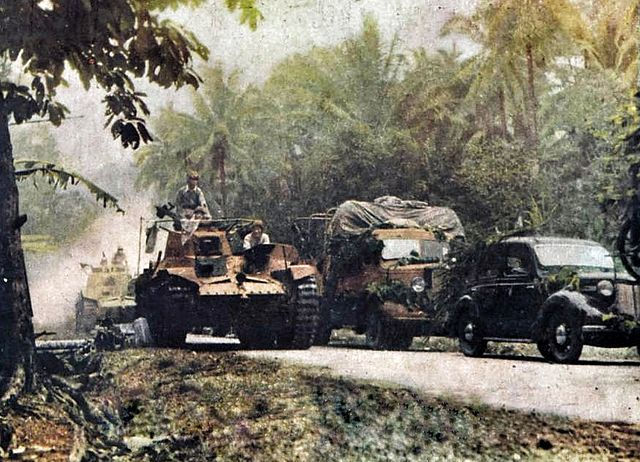
But that in itself might've been wishful thinking, given that the British defense doctrine, static and rigid, was repeatedly overcome by the Japanese's rapid flanking maneuvers. Moreover, the Japanese were very aggressive, unafraid of close-quarters combat (in fact, they loved bayonet fighting), and experienced. Loss of
Logistical Crisis Across Southeast Asia
Japan cannot simply replace lost transports like the United States could once its shipbuilding was at peak production. Shipbuilding capacity was limited, and the nation was already cobbling together its invasion fleets using converted merchantmen and leased vessels. By 1942–43, Allied submarines increasingly preyed on Japanese shipping, making it that much more difficult.
Losing even 3–5 major transports in December 1941 forces immediate consequences, including:
Rerouting transports from the Philippines or Borneo.
Delaying the Burma invasion timetable.
Slowing or scaling down reinforcements for the Dutch East Indies.
Diverting merchant hulls from supply missions to troop carriage.
Every diverted ship means another garrison goes short on food, ammunition, or fuel. All of this would have consequences for how the Japanese prosecute the war in the opening days and months.
How would it affect the war's progression?
The shape of the Pacific War, especially in 1942–43, may be significantly altered. Such things that might've been affected include:
Malaya falls later and at a higher cost.
Singapore holds longer, possibly allowing additional time for the evacuation of troops and equipment (though Churchill already committed to defending Singapore to the last).
The Burma campaign becomes far less synchronized.
Guadalcanal and New Guinea receive even weaker Japanese supply lines.
Merchant fleet collapse accelerates, shortening Japan’s ability to sustain operations across its vast territory.
The real strategic pressure point is not Singapore or the Philippines — it’s Japan’s fragile transport infrastructure. A few sunken transports in December 1941 act like dominoes, tipping later operations into deeper vulnerability.
A Missed Blow That Could've Reshaped the Early Pacific War
Force Z’s failure was the result of multiple bad decisions and failures. However, had Prince of Wales and Repulse found and successfully engaged the Japanese fleet, they might've struck a blow that would've made it harder for Japan logistically to carry out all the campaigns it had planned. t
In this alternate timeline, the Royal Navy’s doomed sortie delivers a devastating opening blow to Japanese logistics, slowing invasions, straining resources, and accelerating the merchant fleet death spiral that would ultimately cripple Japan. It's a reminder of the importance of logistics. For you can have the strongest weapons and most well-trained force in the world, but if you can't keep them supplied, it really doesn't matter.
So, how different would the opening months of the Pacific War look if Force Z had found its mark? Different enough to matter in how the war progresses, but not enough to save the collapse of the British in Malaya and elsewhere across Asia.
The following podcast inspired this post. I highly recommend checking it out if you're interested in a more detailed account of the fate of Force Z:
Sources
Barnett, C. (1964). The Swordbearers: Studies in Leadership in the First World War. William Morrow.
Brown, D. (1995). Warship Losses of World War Two. Naval Institute Press.
Chalfont, A. (1980). Malayan Emergency (2nd ed.). Gerald Duckworth.
Dull, P. S. (1978). A Battle History of the Imperial Japanese Navy, 1941–1945. Naval Institute Press.
Evans, D. C., & Peattie, M. (1997). Kaigun: Strategy, Tactics, and Technology in the Imperial Japanese Navy, 1887–1941. Naval Institute Press.
Hayashi, S. (1955). Kōgun: The Japanese Army in the Pacific War. Marine Corps Association.
Hough, R. (1963). The Hunting of Force Z. Collins.
Jackson, A. (2004). The Fall of Singapore 1942. Oxford University Press.
Morison, S. E. (1948). History of United States Naval Operations in World War II: Vol. 3, The Rising Sun in the Pacific. Little, Brown and Company.
Navweaps.com. (n.d.). Order of Battle — WWII Pacific: Force Z. Retrieved [date accessed], from http://www.navweaps.com/index_oob/OOB_WWII_Pacific/OOB_WWII_Force-Z.php
Ong Chit Chung. (2011). Operation Matador: Britain’s War Plans Against the Japanese 1918–1941. NUS Press.
Pacific Eagles. (n.d.). The Defeat of Force Z. Retrieved [date accessed], from https://pacificeagles.net/the-defeat-of-force-z/ Pacific Eagles
Rohwer, J., & Hümmelchen, G. (1992). Chronology of the War at Sea 1939–1945. Naval Institute Press.
Smith, C. (2006). Singapore Burning: Heroism and Surrender in World War II. Viking.
War History Online. (n.d.). The end of the battleship: HMS Prince of Wales & Repulse sunk — 10th December 1941. Retrieved [date accessed], from https://www.warhistoryonline.com/instant-articles/end-battleship-hms-prince-wales-repulse-sunk-10th-december-1941.html
Willmott, H. P. (1982). Empires in the Balance: Japanese and Allied Pacific Strategies to April 1942. Naval Institute Press.
Young, P. (1971). World War II: The War at Sea. Octopus Books.
Images
Imperial War Museums. (1941, December 10). HMS Prince of Wales and HMS Repulse underway with a destroyer, 10 December 1941 [Photograph]. Wikimedia Commons. https://commons.wikimedia.org/wiki/File:HMS_Prince_of_Wales_and_HMS_Repulse_underway_with_a_destroyer_on_10_December_1941_(HU_2762).jpg
Unknown author. (n.d.). Pacific War – Malaya 1941–42 map [Map image]. Wikipedia. https://en.wikipedia.org/wiki/Malayan_campaign#/media/File:Pacific_War_-_Malaya_1941-42_-_Map.jpg
Unknown author. (n.d.). HMS Prince of Wales in Singapore, December 1941 [Photograph]. Wikimedia Commons. https://commons.wikimedia.org/wiki/File:HMS_Prince_Of_Wales_in_Singapore.jpg
Unknown author. (n.d.). HMS Repulse, 30 October 1926 [Photograph]. Wikimedia Commons. https://commons.wikimedia.org/wiki/File:HMS_Repulse,_30_October_1926.jpg
Australian War Memorial. (1942). Japanese troops in final stages of conquest — Singapore, Johor Bahru [Photograph]. Wikimedia Commons. https://commons.wikimedia.org/wiki/File:Japanese_troops_final_stages_to_conquest_Singapore,_Johore_Bahru_(AWM_127900).JPG
Unknown author. (n.d.). Japanese armour in Malaya, 1942 [Photograph]. Wikimedia Commons. https://commons.wikimedia.org/wiki/File:Japanese_Armor_in_Malaya_1942.jpg


Comments