


Facing Ten Thousand at Bezek

Updated: Apr 21
Wars of the Bible
In Part 2 of The Conquest of Canaan, we followed Joshua as he led Israel in the conquest of the land of Canaan. After securing the south, Israel faced a formidable northern coalition led by Hazor and its king, Jabin. This alliance brought together a vast army.
And they came out with all their troops, a great horde, in number like the sand that is on the seashore, with very many horses and chariots.
Joshua 11: 5
Yet despite the scale of this threat, the outcome echoed a consistent theme throughout Joshua’s campaigns: victory did not depend on Israel’s strength, but on their faith in the Lord and his power. At the Waters of Merom, Joshua struck swiftly, routing the coalition and pursuing them across northern Canaan. The destruction of Hazor, the head of these kingdoms, marked the collapse of organized resistance in the north.
By the end of Joshua 11, there was still more work to do. We see this in Joshua 13.
Now Joshua was old and advanced in years, and the Lord said to him, “You are old and advanced in years, and there remains yet very much land to possess. 2 This is the land that yet remains: all the regions of the Philistines, and all those of the Geshurites 3 (from the Shihor, which is east of Egypt, northward to the boundary of Ekron, it is counted as Canaanite; there are five rulers of the Philistines, those of Gaza, Ashdod, Ashkelon, Gath, and Ekron), and those of the Avvim, 4 in the south, all the land of the Canaanites, and Mearah that belongs to the Sidonians, to Aphek, to the boundary of the Amorites, 5 and the land of the Gebalites, and all Lebanon, toward the sunrise, from Baal-gad below Mount Hermon to Lebo-hamath, 6 all the inhabitants of the hill country from Lebanon to Misrephoth-maim, even all the Sidonians. I myself will drive them out from before the people of Israel. Only allot the land to Israel for an inheritance, as I have commanded you. 7 Now therefore divide this land for an inheritance to the nine tribes and half the tribe of Manasseh.”
Joshua 13: 1-7
While Joshua’s campaigns broke the power of the major Canaanite coalitions, they did not result in the complete removal of all inhabitants. Many cities remained unconquered, and pockets of resistance persisted throughout the land. Joshua, the central military leader who had guided Israel since the days of Moses, would not lead these final efforts. With his death at the end of the book bearing his name, leadership would shift—not to another singular figure—but to the tribes themselves, beginning with one in particular.
The Rise of Judah
As the narrative moves into the Book of Judges, the question arises: Who will lead now?
The answer comes quickly. The tribe of Judah is chosen to go first.
This is significant both historically and theologically. Judah was already emerging as a dominant tribe among the Israelites, and its leadership here foreshadows its future prominence in Israel’s story from the monarchy of David to its lasting identity within the nation.
But unlike Joshua’s campaigns, Judah’s task would be far more fragmented and difficult. Instead of facing a single coalition, they would confront isolated strongholds, entrenched city-states, and lingering enemies who had adapted to Israel’s presence.
The Continuing Conquest of Canaan
1 After the death of Joshua, the people of Israel inquired of the Lord, “Who shall go up first for us against the Canaanites, to fight against them?” 2 The Lord said, “Judah shall go up; behold, I have given the land into his hand.” 3 And Judah said to Simeon his brother, “Come up with me into the territory allotted to me, that we may fight against the Canaanites. And I likewise will go with you into the territory allotted to you.” So Simeon went with him. 4 Then Judah went up and the Lord gave the Canaanites and the Perizzites into their hand, and they defeated 10,000 of them at Bezek. 5 They found Adoni-bezek at Bezek and fought against him and defeated the Canaanites and the Perizzites. 6 Adoni-bezek fled, but they pursued him and caught him and cut off his thumbs and his big toes. 7 And Adoni-bezek said, “Seventy kings with their thumbs and their big toes cut off used to pick up scraps under my table. As I have done, so God has repaid me.” And they brought him to Jerusalem, and he died there.
Judges 1: 1-7
The History, People, and Place of this Battle
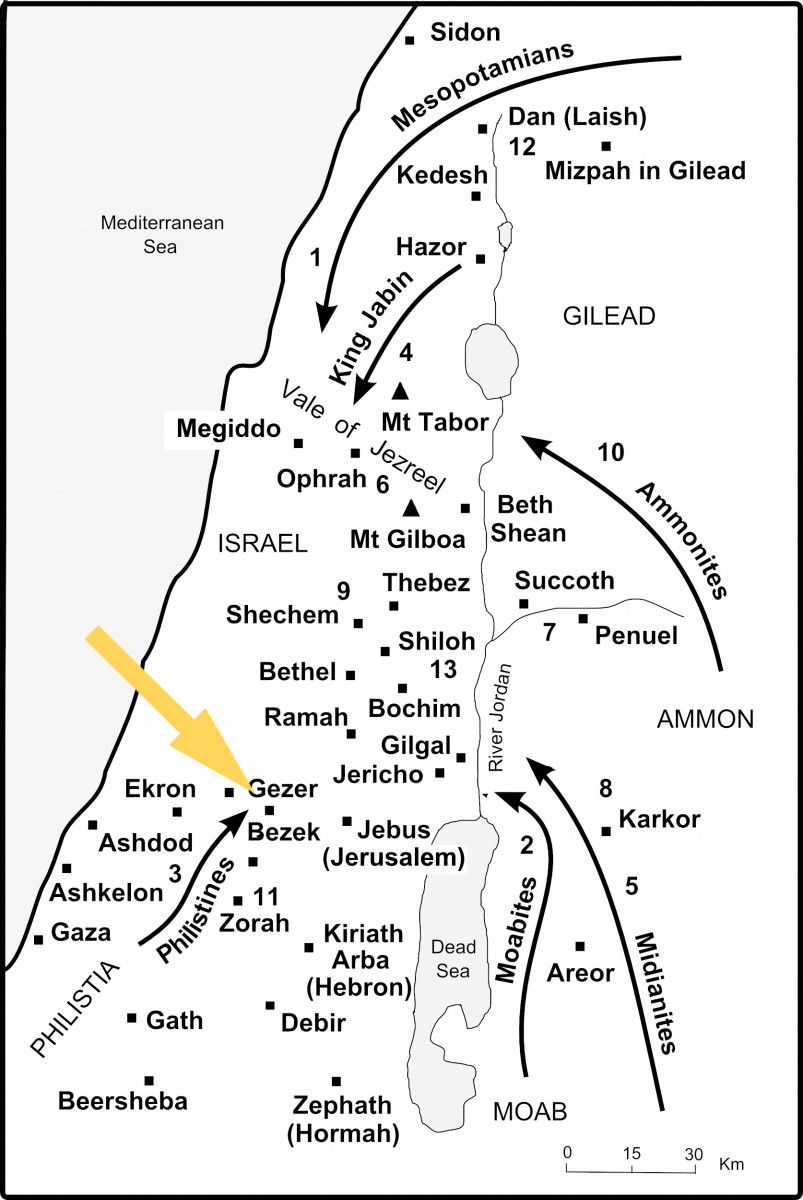
As we move into Judges, the nature of Israel’s conflict in Canaan begins to shift. No longer united under Joshua’s centralized command, the tribes now operate more independently, seeking direction from the Lord before engaging in battle. Judah is chosen to lead, and with Simeon, his brother, at their side, they advance against a coalition of Canaanites and Perizzites at Bezek. The encounter results in a decisive victory and the capture of a local ruler, Adoni-Bezek.
Unlike major cities such as Hazor, which have been extensively excavated and yield clear archaeological layers of destruction, there is no direct archaeological evidence confirming the specific battle described in Judges 1:1–7. This absence, however, is not unusual. Smaller engagements, especially those involving regional forces rather than major urban centers, rarely leave behind identifiable traces. Many of the relevant sites remain only partially excavated, and the early Iron Age itself is a period where the archaeological record is comparatively sparse.
What archaeology does reveal, however, strongly supports the broader setting described in the text. During this period, Canaan was not a unified kingdom but a patchwork of small settlements and fortified towns, each ruled by local leaders. Evidence of regional conflict, shifting populations, and settlement disruption aligns well with the decentralized warfare depicted in Judges. Rather than grand, sweeping campaigns, we begin to see a landscape defined by localized struggles for control.
This context helps us better understand the groups mentioned in the passage, particularly the Perizzites. In the biblical text, they are consistently listed alongside other inhabitants of Canaan, yet they do not appear as a distinct people group in extra-biblical sources. Most scholars believe the term refers not to a separate ethnicity but to a way of life. The name likely denotes rural or village dwellers, distinguishing them from those living in fortified city-states. In this sense, the Perizzites were almost certainly part of the broader Canaanite population, representing communities that existed outside the major urban centers.
At the center of this encounter is Adoni-Bezek, whose name means “lord of Bezek.” This is less a personal name and more a title, suggesting his role as a local ruler or warlord governing the surrounding area. His authority likely extended over a mixed population, including both Canaanites and Perizzites.
The location of Bezek itself remains uncertain, though many scholars identify it with Khirbet Ibziq, a site northeast of Shechem. While the site shows evidence of ancient occupation, no excavation has uncovered a destruction layer or inscription that can be definitively tied to the battle in this passage. As with many smaller sites from this period, the material record is limited, leaving us to rely on broader patterns rather than specific confirmations.
Taken together, Judges 1:1–7 reflects a historical reality consistent with what archaeology reveals about the period. The world of this passage is one of fragmented authority, local rulers, and frequent regional conflict. It is a continuation of the conquest, but under very different conditions. The sweeping victories under Joshua have given way to a slower, more complex process of securing the land—one that will define the era of the Judges and reveal both the strengths and struggles of Israel as they attempt to fully claim what had been promised.
My Spiritual Takeaway
After having a singular leader for so long who had led them through so many victories, it must have been difficult for the Israelites not to give in to fear as they had done before. But this time, we see them turn to God for answers, and he responds by naming Judah.
When God Calls, We Should Answer in Faith
This is a good reminder not only to turn to God for the answers we need, but also to respond when we receive them. Even when it's an answer we weren't looking for or expecting.
In another turn, we see how Judah makes a deal with his brother to help each other clear the lands allotted to them (this was explained at the end of the Book of Joshua; see map below for more context).

This alliance of brothers is also a great moment and model for siblings. David would echo such sentiments in Psalm 133.
We Should Dwell With Our Brethren in Unity Under God
We see in the bible families torn apart by human sin. When we are in Him, it not only makes us better individually, but it makes our families stronger. Every family has problems and challenges, rivalries and hurt, but good things come to those families and siblings who seek unity under God rather than disunity (often for selfish reasons).
We also see a nod to retributive justice in the character, anonymously named Adoni-Bezek.
Adoni-bezek fled, but the Israelites pursued him and caught him and cut off his thumbs and his big toes. 7 And Adoni-bezek said, “Seventy kings with their thumbs and their big toes cut off used to pick up scraps under my table. As I have done, so God has repaid me" (Judges 1:7).
This might seem quite brutal, but it was a way to ensure that the defeated lord would not wield weapons and lead men in battle again. His comment acts a retributive justice for his transgressions against others.
Beware, For We Reap What We Sow
This is a lesson for us all. For as we read in Galatians, we reap what we sow. So we should tread with care and exhibit the fruits of the spirit, for our failures and sins tend to come back around, as they did for Adoni-bezek.
In the next blog, we’ll continue with the Israelite’s conquests across Canaan that are both successful and those that fail.
Sources
Ben-Tor, A. (2016). Hazor: Canaanite metropolis, Israelite city. Israel Exploration Society.
Dever, W. G. (2003). Who were the early Israelites and where did they come from? William B. Eerdmans.
Finkelstein, I., & Silberman, N. A. (2001). The Bible unearthed: Archaeology’s new vision of ancient Israel and the origin of its sacred texts. Free Press.
Goren, Y., Finkelstein, I., & Na’aman, N. (2004). Inscribed in clay: Provenance study of the Amarna tablets and other ancient Near Eastern texts. Emery and Claire Yass Publications.
Judges 1:1–7. (n.d.). In The Holy Bible, English Standard Version. Crossway. https://www.biblegateway.com/passage/?search=Judges+1&version=ESV
Joshua 11. (n.d.). In The Holy Bible, English Standard Version. Crossway. https://www.biblegateway.com/passage/?search=Joshua+11&version=ESV
Joshua 13:1–7. (n.d.). In The Holy Bible, English Standard Version. Crossway. https://www.biblegateway.com/passage/?search=Joshua+13&version=ESV
Killebrew, A. E. (2005). Biblical peoples and ethnicity: An archaeological study of Egyptians, Canaanites, Philistines, and early Israel. Society of Biblical Literature.
Mazar, A. (1990). Archaeology of the land of the Bible, 10,000–586 BCE. Doubleday.
Na’aman, N. (1994). Canaanite city-states in the Late Bronze Age. Ugarit-Forschungen, 26, 397–418.
Precept Austin. (n.d.). Joshua 10 commentary [Illustrations and exposition]. https://www.preceptaustin.org/joshua-10-commentary
Redford, D. B. (1992). Egypt, Canaan, and Israel in ancient times. Princeton University Press.
Tel Shimron Excavations Project. (n.d.). Tel Shimron: Excavations and research overview. https://www.telshimronexcavations.com
Wikipedia contributors. (n.d.). Perizzites. Wikipedia. https://en.wikipedia.org/wiki/Perizzites
Wikipedia contributors. (n.d.). Tel Hazor. Wikipedia. https://en.wikipedia.org/wiki/Tel_Hazor
Wikipedia contributors. (n.d.). Khirbet Ibziq. Wikipedia. https://en.wikipedia.org/wiki/Khirbet_Ibziq
Images
English School. (n.d.). The defeat of Adonizedek [Lithograph]. Bridgeman Images. https://www.meisterdrucke.us/fine-art-prints/English-School/446986/The-Defeat-of-Adonizedek.html
The Bible Journey. (n.d.). The Israelites fight the remaining Canaanites. https://www.thebiblejourney.org/biblejourney2/28-the-israelites-face-continuing-opposition/the-israelites-fight-the-remaining-canaanites/
Weebly. (n.d.). Adoni-Bezek. https://atthattimedaniel12.weebly.com/adoni-bezek.html


Comments